
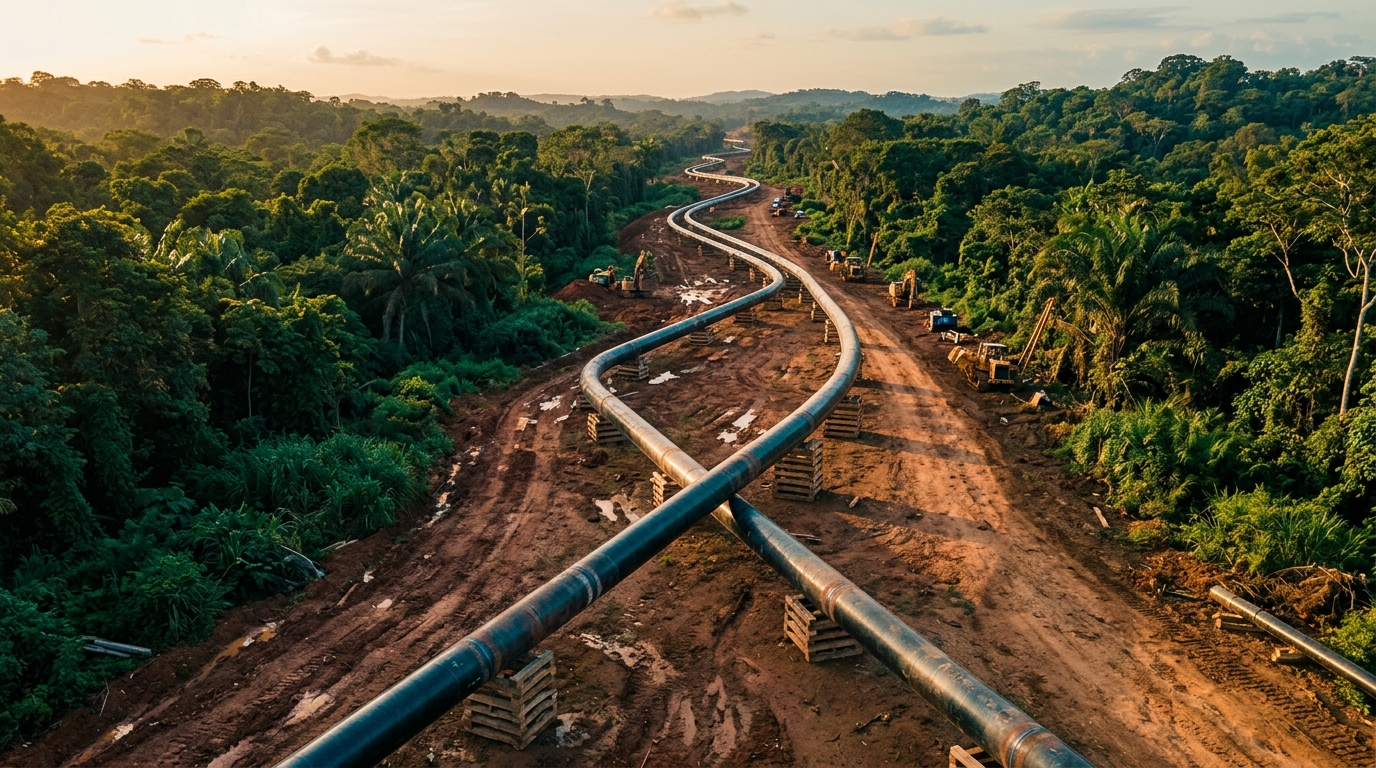
A pipeline is a straight line drawn across a country that rarely wants to accept it. Between the design corridor and a commissioned line lies a sequence of disciplines — surveying, land access, civil works, welding, testing, environmental closure — that must arrive in order and on time. When any one arrives late, the schedule multiplies. This article walks through the full arc of pipeline construction in Venezuela, from the first survey stake to the vegetation that eventually hides the right-of-way, and describes what a serious contractor brings to each stage.
Before the first cut: route, permits, land
Every pipeline project succeeds or fails in the quiet months before the trench opens. Route selection balances hydraulics, geotechnical risk, environmental sensitivity and — critically in Venezuela — the reality of land access. Permits from national and regional authorities must precede mobilization; landowner agreements along the corridor must precede permits; and the survey that anchors all of it must be honest, not aspirational. A contractor with local depth compresses this stage because it knows which offices to visit in which order, and which corridors present risks the drawings do not mention.
The construction sequence, in the order it actually happens
- Right-of-way preparation. Vegetation clearing to the minimum necessary width, topsoil separated and stockpiled for later reuse, drainage that respects the natural regime. A well-prepared ROW is the first evidence of environmental discipline — and the foundation of every phase that follows.
- Ditch excavation. Depth to specification, walls stable, spoil placed on the opposite side from the stringing lane. In wet terrain, dewatering runs in parallel; in rocky terrain, blasting or ripping is planned with the environmental team.
- Stringing. Pipe sections delivered along the ROW on timber skids, positioned so the welding crew moves forward without waiting on logistics. This is where owned trucking capacity separates schedules from wishes.
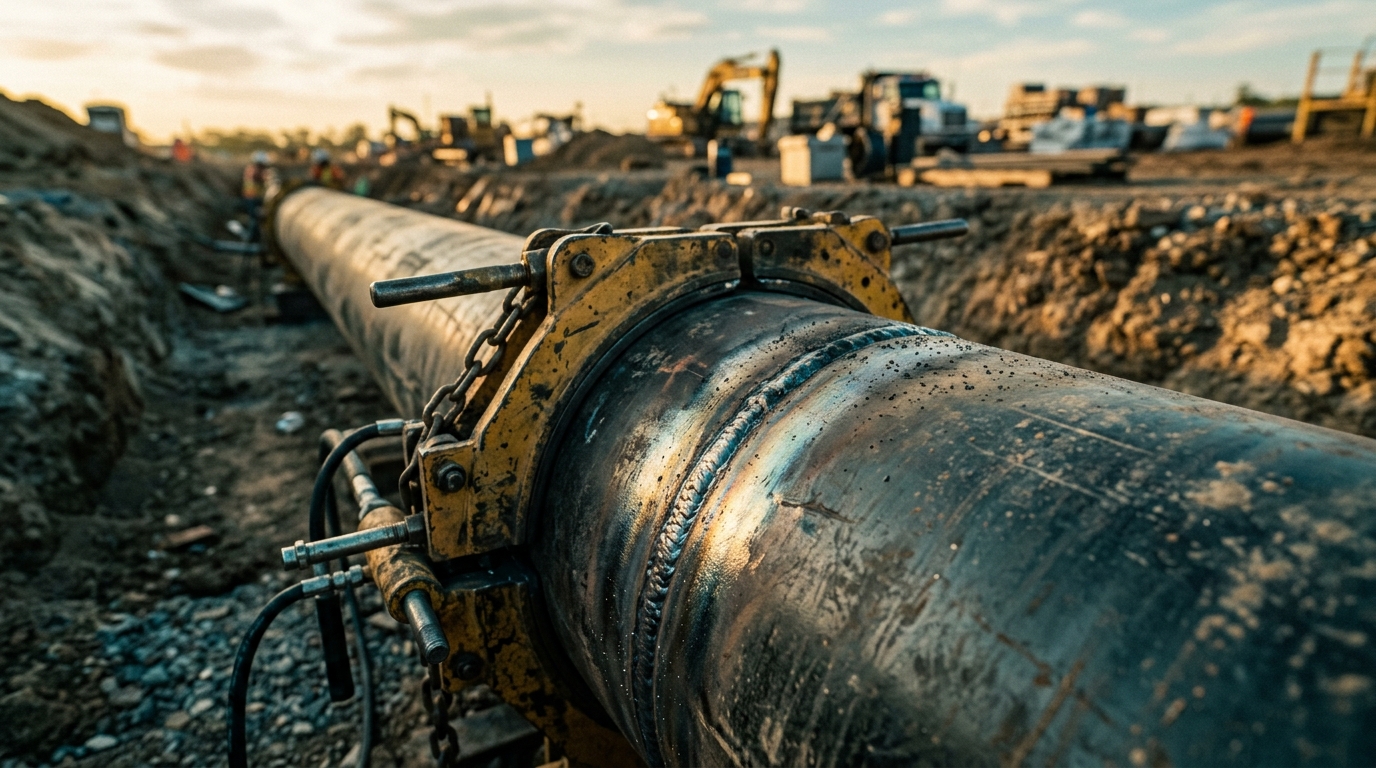
- Welding. Qualified procedures per API 1104, welders qualified for the specific material and thickness, and inspection integrated into the sequence — not tacked on. Full non-destructive testing with radiography or automated ultrasonics, acceptance criteria documented, and a repair procedure that leaves an audit trail.
- Coating and joint protection. Field joints coated to the same standard as the factory-applied pipe, with holiday testing before backfill. A pipeline's lifetime is written in its coating integrity.
- Lowering-in and backfill. Coordinated lifts along the string, padding material at contact points, careful placement to protect the coating. Topsoil returns last, in reverse of the order it was removed.
- Hydrotest. Fill, pressurize, hold, document. The pressure trace is a signature that will be filed for the life of the asset.
- Tie-ins and commissioning. Cold cuts or hot tie-ins as design and operations dictate, purge and pack, and handover with as-built records that match reality.
- Environmental closure. Re-contouring, drainage restoration, revegetation with species that will take. Not a checkbox — the visible legacy of the project.
Where Venezuelan pipeline projects are won
Three field disciplines separate the schedules that hold from the ones that slip. First, welding productivity: enough qualified welders, enough machines, and a rhythm that keeps inspection close behind the crew — not chasing them a kilometer later. Second, logistics honesty: pipe, welding gas, coating material, water for hydrotest, all planned as sequences and not as promises. Third, environmental co-execution: closure work that starts as soon as a section is lowered-in and backfilled, rather than accumulating into a punch list at the end. That last discipline is also what makes ESG evidence — the topic we developed in our sustainability guide — a natural byproduct rather than an afterthought.
What LATICON's pipeline unit brings
Our onshore facilities and pipelines unit executes the full arc under one contract: civil ROW preparation, welding qualified under API 1104, inspection with certified NDT, coating and hydrotest, tie-ins and commissioning, and the environmental closure that returns the corridor to its landscape. Owned equipment along the ROW, our own workshops for prefabrication of complex segments, and crews formed over three and a half decades of building lines across Zulia and Anzoátegui. The absence of interfaces between subcontractors is not a marketing point in pipeline work — it is a schedule fact.
Pipeline contractor: what to verify
- Welding procedures and welder qualifications per API 1104
- NDT capability documented — radiography or automated UT — with acceptance criteria
- Coating discipline including field joints and holiday testing
- Owned ROW logistics: trucking, side-boom crawlers, welding tractors
- Hydrotest procedure with instrument calibration records
- Environmental closure integrated into the sequence, not deferred
- References with pipeline scopes completed within schedule and permit
Frequently asked questions
What are the main phases of pipeline construction?
Route survey and permitting, ROW preparation, excavation, stringing and welding, coating, lowering-in, hydrotest, tie-ins and commissioning, and environmental closure with revegetation.
What welding qualifications matter?
Welder qualifications under API 1104, procedures qualified for the base material and thickness, and a full NDT regime with documented acceptance and repair procedures.
Where does environmental closure fit?
Planned from day one. Topsoil separated during excavation, ROW re-contoured after hydrotest, revegetation on the same season. A ROW that recovers within two rainy seasons is the mark of a serious contractor.
Planning a pipeline scope in Venezuela?
Full ROW-to-revegetation execution under one contract. Owned logistics, qualified welding, integrated environmental closure.