
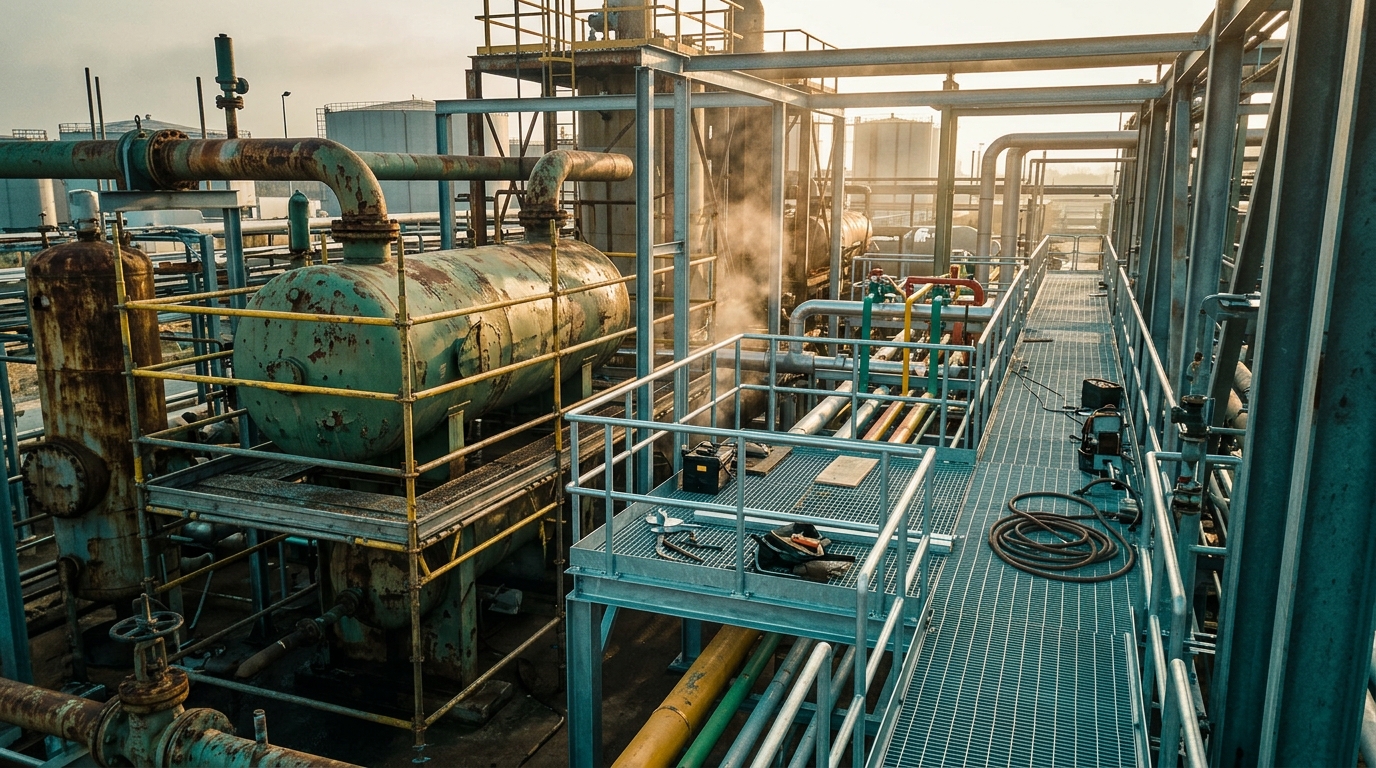
Greenfield construction tests how well you can build; brownfield tests how well you can build around what already exists — and Venezuela's current cycle is overwhelmingly brownfield. Flow stations, pipelines, platforms and substations that operated for decades are being brought back to standard, and the contractors executing that work face conditions no drawing fully describes. This article contrasts the two execution disciplines and details the practices that keep reactivation projects on schedule when the ground insists on surprising you.
Two disciplines, one trade
A greenfield site is an empty canvas: clean survey, clean sequencing, productivity limited mainly by logistics and weather. Brownfield inverts every one of those assumptions. The as-built drawings — when they exist — describe the facility as someone intended it decades ago, not as successive modifications left it. Production is often live a valve away from the work front. And the true condition of steel, concrete and buried lines reveals itself only when scaffolding goes up, coatings come off and the first excavation opens.
The economic consequence is that brownfield risk concentrates not in the visible scope but in the discovered one. Estimating and executing it well is a specific competence, built project by project — the competence Venezuela's reactivation now demands at scale.
Where brownfield projects are won
- Verification before commitment. Topographic and dimensional surveys, integrity spot-checks and buried-services detection before the schedule is baselined. An honest week of verification saves a claim-ridden quarter.
- Permit-to-work and SIMOPS discipline. With live production nearby, every hot work, lifting or line-break task runs under permits coordinated with operations. We treat the operator's permit system as the project's heartbeat — a habit formed across decades of working inside producing fields, onshore and on the lake.
- Tie-in windows planned like launches. Shutdown windows are short and expensive. Prefabrication in workshop, trial fits, and crews rehearsed on the sequence turn a 72-hour window into a routine instead of a gamble. Our workshop fabrication and on-site assembly model exists precisely for this.
- Discovery management agreed in advance. A change process with pre-agreed rates and decision times, plus hold points at discovery-prone stages, keeps surprises from becoming disputes.
- Materials strategy with reality margins. Aging facilities consume more replacement steel than surveys predict. Experienced contractors carry contingency stock — and owned logistics to move it fast.
What greenfield still demands
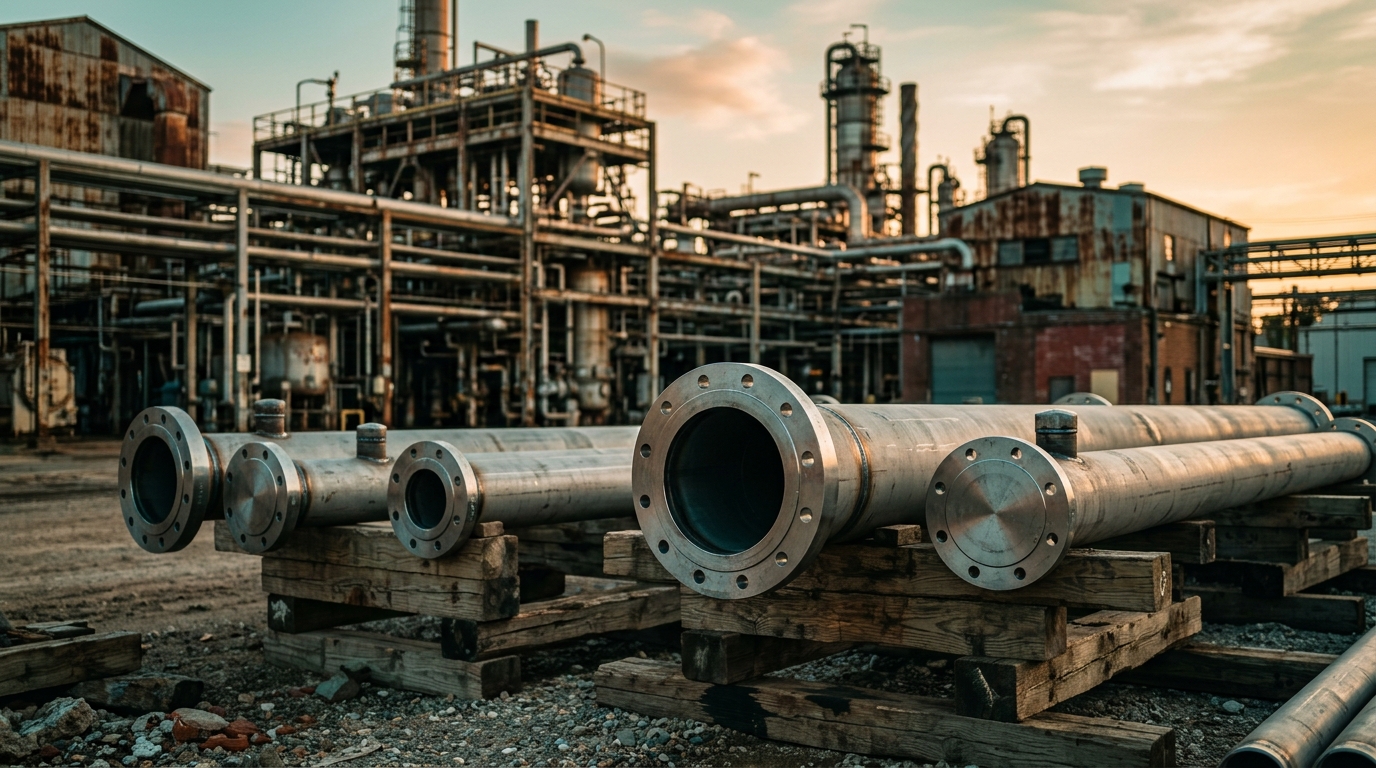
None of this diminishes greenfield discipline. New facilities, wellpads and pipelines — the scopes that follow reactivation — reward classical strengths: site preparation quality, dimensional control from the first pour, and logistics that feed work fronts without pause. The contractors best positioned for the coming years are those fluent in both grammars, because Venezuela's project list will interleave them: a rebuilt flow station here, a new gathering line there, often under the same contract.
Experience as risk control
Our conviction, after three and a half decades that included every kind of cycle: in brownfield, the contractor's experience is the operator's primary risk control. Crews that have opened a hundred old flanges know what the hundred-and-first may hide. Supervisors who worked these specific fields — Boscán, the lake's east coast, the Anzoátegui plains — carry as-built knowledge no archive preserved. That is the capability LATICON's asset integrity and construction units bring to reactivation programs, and it is why this cycle's first wave is being executed by firms that never left.
Brownfield readiness checklist
- Field verification survey before schedule baseline
- Integrity spot-checks on structures receiving new loads
- Buried services detection before excavation
- Permit-to-work integration with operations agreed at kickoff
- Prefabrication and trial fits ahead of tie-in windows
- Discovery change process with pre-agreed rates
- Contingency materials and owned logistics on standby
Frequently asked questions
What makes brownfield riskier than greenfield?
As-builts that rarely match reality, live production that turns every task into a permits exercise, and asset conditions fully known only after scaffolding and coating removal.
How are unknown conditions managed?
Verification-first sequencing, schedule and material contingency, hold points at discovery-prone stages, and a change process agreed before mobilization.
Is the current cycle brownfield or greenfield?
Overwhelmingly brownfield — the integrity and reactivation backlog comes first. Greenfield grows as production economics consolidate.
Planning a reactivation scope in Venezuela?
Bring us the survey — or let us run it. Brownfield procedures, workshop prefabrication and crews formed in these exact fields.